
I have previously written about Amy Cuddy and her disgraced claim about Power Posing.
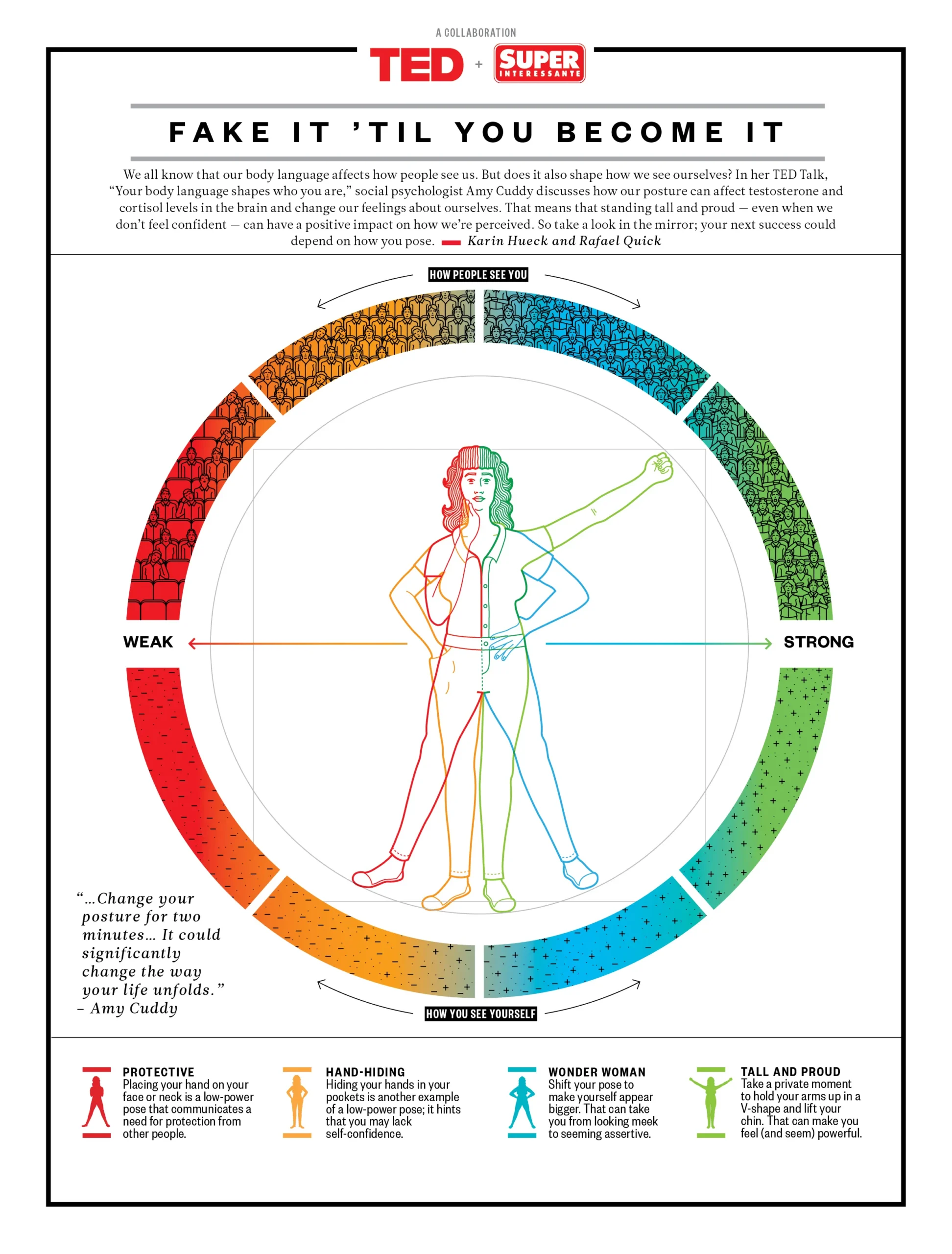
Fake it till you make it? .. and NEVER stop faking it?
Very short summary:
- The original study, where Cuddy was second author, had several severe methodological flaws that gravely undermined the findings
- Cuddy gave a wildly popular TED talk on the topic, and has garnered a lot of attention and opportunities for lucrative public speaking lectures, courses etc.
- The results were called out by a team from Data Colada.
- Amy Cuddy doubled down, her co-author accepted the critique and withdrew.
- Cuddy left her position at Harvard, and for all intents and purposes, left research and academia.
In a long post on LinkedIn in February 2026, Cuddy argues that a large number of scientific studies have now proven that they were correct in their first article (and thus, that the content of her TED talk etc. is correct as well).
In a post on his blog, and on LinkedIn, Daniel Lakens, a scientist who specializes in research methods, examines Cuddy’s claims, and finds a host of problems, ranging from citing fictitious articles, to misrepresenting results, at times claiming the exact opposite of what the study found.
Njål’s Reflections:
- To check claims like Lakens has done, probably requires a lot more time, effort and expertise than making the claims in the first place. This is particularly true when the claims are false or misleading.
- There is strong evidence that much of the work behind Cuddy’s post was uncritically conducted using an LLM; which further skews the ratio of effort.
- It also requires significant knowledge/expertise to evaluate Lakens’ claims, and judge them against Cuddy’s claims, meaning the audience for such corrections is limited.
- On LinkedIn, Cuddy has 910 934 followers, Lakens has 8 136, less than 1% of Cuddy; which means that Cuddy’s version will reach wildly more people.
- Both Lakens and Cuddy may have reached their intended objectives. Cuddy is an author and keynote speaker, who needs publicity and credibility. Lakens is a scientist, whose expertise is on research methods. Based on a very brief AI analysis of the discourse that has followed, we see that
- Lakens has received wide and strong support from the scientific community, who do not see this as bullying, but as an important part of the scientific process, of verifying and evaluating evidence
- Cuddy has received wide support from various practitioners, who cite their own experiences that Power Posing works for them.
- Admittedly, the support reads much like support for any other placebo!
- The peril of being a “one-hit-wonder”. Amy Cuddy seem to have a single claim to fame: her “Power Pose” rhetoric. There are interesting aspect of it, with a solid basis of physical display of power and signaling, seen across the animal kingdom. However, the research article was first published in 2010, and seems to be the single topic and insight Cuddy is still promoting and working with. Should one have pause to think about the quality of a researcher who is unable to renew themselves? Should it evoke pity? Or should one appreciate that sometimes, one only has a single good idea that catches on?
Where does this leave us? I do not know, but am left thinking about the great divide between academia and science on the one side, and the public and practitioners on the other. We see increased skepticism to elites, including knowledge elites, and the grown of populism with simplified ideas. Will education remain a bulwark? Possibly.
Does the ability to read, understand and evaluate scientific evidence have the potential to be a huge comparative advantage for the individual? DEFINITELY. The ability to select and investing in the most promising technology and practices remain, but as fewer are able, the relative reward will only increase.
Summary from AI on the ongoing debate:
-
- The Allegation: In his rebuttal, Lakens claimed that one of the descriptions of “supporting evidence” in Cuddy’s post was likely an AI-generated hallucination of a non-existent paper. He also noted other instances where she appeared to cite findings that actually showed the opposite of her claims. [1, 2]
- Academic Shock: This specific detail drove a wave of disbelief among scientists. Commenters like Edith Beerdsen (Associate Professor of Law) noted that the text had clear markers of AI generation, while others like behavioral scientist Michael Snelgrove called the issue of fake citations “shocking” and thanked Lakens for the “kickass analysis”. []
- The “Irony” Critique: A recurring theme among critics was the irony of Dr. Cuddy defending scientific integrity while allegedly using non-existent sources. As commenter Noah Motion put it, it was “depressing and kind of amazing” to see a defense of scientific discourse that simultaneously eroded trust by “citing papers that don’t exist”. []
-
- “Criticism is Healthy”: John Antonakis, a prominent organizational behavior professor, commented that Lakens’ response was “entirely appropriate,” emphasizing that “criticism in science is healthy” and that labeling such critiques as personal attacks is a “straw man argument”. []
- Rejection of the “Bullying” Narrative: Dr. Cuddy had framed the pushback against her as an attempt to “silence” her and implied she was being bullied. The scientific community largely pushed back on this, arguing that pointing out errors—especially hallucinated citations—is a fundamental duty of peer review, not harassment. []
- Intuition Over Statistics: Supporters like Jill Duvall argued that for them, power posing “wasn’t about statistics or debate—it was about experience.” The prevailing sentiment in this camp was that if the technique provides “permission to feel confident,” it is valuable regardless of whether the hormonal changes (testosterone/cortisol) are statistically replicable.
- Testimonials: The comments on Cuddy’s original post were filled with personal anecdotes from users who claimed the technique helped them through job interviews and difficult conversations, effectively saying, “If it works, it works”. [1, 3]